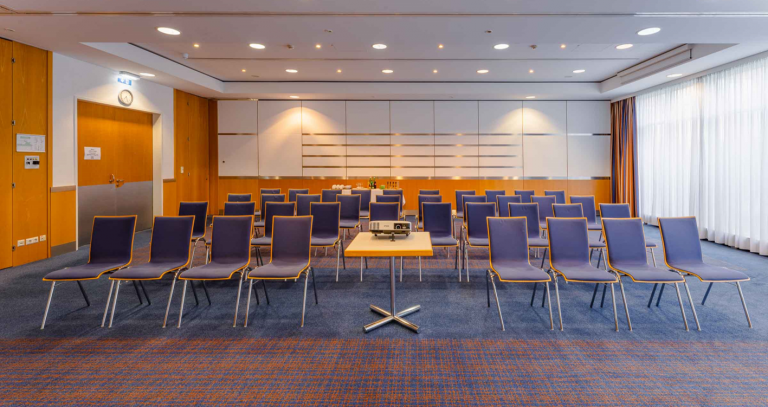
A client event rarely fails because of a single bad decision. Usually it's a number of small points of friction: the journey is awkward, the reception gets congested, the stage looks too small, the catering arrives late or conversations are drowned out by noise. If you want to plan a client event venue successfully, don't start with pretty pictures – start with the experience your guests are actually meant to have.
A product launch calls for different criteria from a networking evening, a summer party or a client workshop. The right venue is not necessarily the most spectacular one. It has to support the goal of the event, work reliably and match the effort your team can realistically handle.
Define the event goal first, then choose the venue
Before comparing spaces, write one clear sentence: what should guests think, know or do after this evening? For a client event, that might be making a new offer easy to understand, deepening relationships, developing leads or showing existing clients your appreciation.
That sentence settles the question of space. If your sales team is to hold personal conversations, you need quiet corners, good acoustics and enough standing room. If a presentation is the focus, sight lines, lighting control, sound system and a stage count for more than a large outdoor area. For a workshop with key accounts, flexible group rooms are often more useful than an impressive event hall.
The guest list changes the requirements too. 40 invited decision-makers usually expect a different setting from 250 guests drawn from a broad community. Don't plan only with the number of acceptances. For free evening events, actual attendance can be considerably lower, whereas for exclusive formats with personal invitations the turnout tends to be higher. A venue that feels pleasantly lively with 100 people can seem disproportionately empty with 65.
Reading capacity correctly
The maximum number of people in a venue profile is a guideline, not a finished room plan. It often refers to a particular seating layout and does not automatically take into account stage, control desk, cloakroom, buffet, sponsor areas or product stations.
So work backwards from the schedule. If a reception, a presentation and networking afterwards are planned, the space should allow for several uses. A change of room can create excitement but takes time and needs clear signage. In historic buildings or sprawling venues, check routes, steps and lifts especially early – above all if accessibility matters for your guests.
Planning a client event venue: the schedule is the floor plan
Think of the event as a journey: arriving, getting your bearings, being welcomed, taking part, eating and drinking, talking, leaving. Every stage shows whether a venue really fits.
The first impression is often made outside the door. Is there a clear address, a visible entrance and room for a welcome team? For events in central Vienna locations, public transport access can be excellent, while deliveries, parking and taxi drop-off need considerably more coordination. For venues outside the city, the balance is often reversed. Then parking, shuttle solutions or well-communicated directions become more important.
Inside, orientation is decisive. Guests should be able to see, without asking, where registration, cloakroom, toilets, main programme and catering are. That sounds trivial but quickly becomes a problem in rambling buildings or with several groups running in parallel. If possible, visit the venue at a similar time of day to your event. Daylight, traffic noise, temperature and lighting mood can change a great deal in the evening.
For client events, acoustics are often the underestimated factor. In rooms with hard surfaces, high ceilings and lots of glass, a networking evening can quickly become tiring. Ask specifically: are there sound-absorbing measures? Is a PA system available? Can music play in one area without disturbing conversations in another? A list of equipment on a website is no substitute for a conversation about your specific format.
| Programme item | What the venue should offer |
|---|---|
| Check-in and welcome drink | Entrance area with little congestion, cloakroom, power and surface space |
| Presentation or talk | Good view from every row, dimmable lighting, sound, enough power for projector or LED wall |
| Dinner or flying buffet | Sensible walking routes, room for service and buffet, no bottlenecks at doors |
| Networking | Seating, quiet zones, a pleasant room temperature and conversations people can hear |
| Product demo | Reliable power supply, secure set-up times and suitable exhibition space |
Compare budgets honestly instead of just adding up room hire
Low room hire can become expensive if equipment, furniture, cleaning, security or extra hours are added later. Conversely, a package price can be better value if it already sensibly covers staff, standard equipment and catering.
So request quotes on a comparable basis. Always give the date, time window including set-up and dismantling, expected number of guests, preferred room layout, programme, catering ideas and technical requirements. Only then can several venues be compared fairly.
The main cost blocks are usually room hire or minimum spend, food and drink, equipment, staff and extras such as branding, cloakroom, cleaning or security. For evening events, pay particular attention to closing times and the cost of extensions. The rules for a reduced number of guests should also be on the table: some venue providers calculate per person, others with a minimum spend or a fixed flat rate.
A realistic buffer makes sense, but it is no free pass for vague planning. Set aside budget above all where requirements may change late: additional equipment, more service staff, weatherproof alternatives to the outdoor area or higher demand for drinks. For summer parties, a plan B for rain can make the difference between a relaxed evening and frantic improvisation.
The questions to settle before you confirm
A lovely site visit is no substitute for a proper briefing. Clarify the critical points in writing before you commit. These include available set-up and dismantling times, the on-site contact person, technical responsibilities and the exact cancellation terms.
When it comes to catering and drinks, it is worth looking closely at the rules. Is an external caterer allowed? Are there minimum spends? Can allergies and vegetarian and vegan options be reliably catered for? At a client event, the service experience directly shapes how your brand is perceived. Long waits at a single bar or a buffet in a narrow thoroughfare can be avoided if you plan guest flows in advance.
Also don't check Wi-Fi and mobile reception only in theory. Check-in tools, livestreams, digital product demos or social media content need a stable connection at the actual event location. Ask for a separate network for production and guests if both will be online at the same time. For sensitive client data or closed presentations, the handling of login details should also be clear.
If you are enquiring with several venues, a consistent scoring matrix helps. Award points not only for price and location but also for schedule, equipment, flexibility, accessibility and the impression the venue team makes. Communication before booking is a good indication of how solution-oriented the collaboration will be on the day of the event.
From quote to a reliable event day
Once the venue is confirmed, you need a schedule that doesn't end when the programme begins. Note when suppliers arrive, who gets access, when equipment is tested and who makes decisions if something doesn't go to plan. A 15-minute buffer before doors open is more helpful than a minutely timed plan with no reserve.
A short joint walk-through with the venue, technical team and caterer before the event saves many rounds of coordination. This is when the reception desk, signage, stage position, power runs, catering areas and emergency exits are finalised. Give one team member the role of keeping the overall picture in view. This person shouldn't have to host, look after guests and solve technical problems at the same time.
When searching for suitable spaces, JustRoom can shorten the groundwork: you compare capacities, facilities and location and send your enquiry directly to the venue – 100% commission-free. But your briefing remains decisive. The more specifically you describe the goal, schedule and conditions, the more reliable the quote will be.
Guests don't notice the best client event venue as an organisational achievement. It simply ensures that conversations happen, content lands and nobody has to think about parking, temperature or a missing plug.