A workshop with 30 people rarely fails for lack of a flipchart. More often, it is held back by break areas that are too small, unstable Wi-Fi, poor acoustics or a room that doesn't allow group work. Anyone searching for the features of a modern event venue therefore wants more than attractive photos. What matters is whether a venue practically supports the planned format - from a focused seminar to a lively company party.
A modern event venue is not a single type of building. An urban loft can be ideal for a creative meeting but unsuitable for a full-day conference with 120 people. A seminar hotel with several rooms and overnight accommodation, on the other hand, offers different advantages. A venue becomes modern where space, AV, service and atmosphere reliably match the occasion.
Modern event venues: more than good design
Of course, design shapes the first impression. Bright rooms, quality furniture, flexible lighting concepts and clear architecture look professional. For organisers, however, design is only a genuine mark of quality if it improves how the space is used. A stylish room with fixed rows of seats is of little help if you want to form four workshop groups.
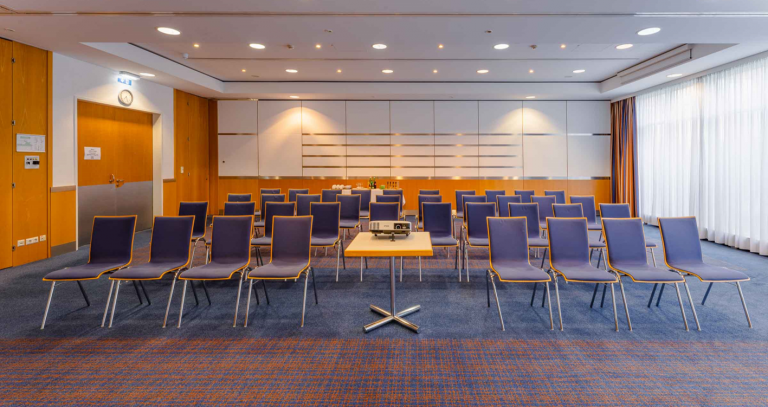
Modern venues therefore think in scenarios rather than just square metres. They show clearly which seating layouts are possible, how many people fit for a talk, a seated dinner or a reception, and which ancillary spaces are available. This saves follow-up questions and prevents a capacity from looking larger on paper than it is in practice.
Flexible room concepts are particularly valuable. Mobile partition walls, lounge areas, quiet zones and well-placed break areas allow you to switch between input, discussion and recovery. This boosts attention. On an eight-hour seminar day, nobody should have to squeeze through a narrow corridor or retreat to the hotel lobby for every coffee break.
The right size is not just a calculation
Don't plan only with the number of participants. Also factor in space for registration, cloakroom, catering, AV, group work and movement. For an interactive training session with 20 people, a 50-square-metre room can work better than a tightly measured room for 30. For a talk, on the other hand, a clear line of sight to the stage matters more than extra group islands.
The position within the building also plays a part. Are all rooms step-free? Is the breakout room right next to the main room? Is there a quiet area for confidential conversations? Details like these determine how the event runs, but are often overlooked in standard descriptions.
Room concept and atmosphere must suit the occasion
A modern event venue gives your format the right stage without pushing itself into the foreground. For a leadership offsite, a seminar hotel on the edge of town with access to nature and overnight accommodation can make sense. For a client event or a product launch, a central industrial hall, a rooftop or a design hotel may be the stronger choice.
Atmosphere isn't created by furnishings alone. Daylight, ceiling height, views, air quality and noise levels influence how long people stay focused. For workshops and training sessions in particular, daylight is a clear advantage. There can be exceptions, though: for film screenings, presentations with strong projections or evening events, a room that can be fully blacked out is easier to control.
| Requirement | How to recognise a suitable venue |
|---|---|
| Workshop with group work | Flexible seating, breakout rooms, whiteboards and enough space to move around |
| Classic conference | Good sightlines, stage or presentation area, professional sound system |
| Networking event | Open reception area, short distances, poseur tables and a visibly placed bar or catering zone |
| Company party | Atmospheric lighting, option for music, a food and drink concept and clear rules on finishing times |
| Hybrid meeting | Stable internet connection, camera positions, microphones and on-site technical support |
Also check how freely you can design the space. Some venues allow branding, individual decoration or external service providers. Others deliberately work with fixed processes and partners. Both can be right. If you have little time for organisation, a well-rehearsed all-in package is often more efficient. If brand staging or special catering is central, you need more freedom.
AV and digital processes have to work
Wi-Fi is no longer an extra. At a modern venue, it should be clear whether there is a separate event network, how many devices can work reliably at the same time and whether the connection reaches the breakout rooms too. Don't settle for "Wi-Fi available". For digital or hybrid formats, ask about bandwidth, access for external speakers and a contact person in case of problems.
Depending on the format, basic equipment includes a projector or display, screen, presentation clicker, facilitation materials, power sockets at seats and a reliable sound system. With more than 40 people, sound quality becomes particularly relevant. A speaker without a microphone is not automatically easier to understand just because the room seems small.
Hybrid events are more demanding. A webcam on a laptop is enough for a short regular check-in, but not for a conference with remote guests. Good event venues offer well-thought-out camera angles, room microphones or headsets, clean lighting and, above all, a tech check before the start. Clarify whether recording, streaming or connecting several rooms is possible. If an external service provider is needed for this, costs and responsibilities should be agreed in advance.
Planning also becomes digitally straightforward at the enquiry stage. Up-to-date availability, transparent capacities, floor plans, technical details and clear price components reduce coordination effort. A fast answer helps, but it doesn't replace a precise one. A quote should make clear what is included in terms of room hire, AV, catering, service staff and any additional hours.
Check service, sustainability and safety visibly
Service shows itself above all when things don't go to plan. If a speaker arrives late, a microphone fails or the number of guests rises at short notice, you need someone who can make decisions. So ask specifically: who will be on site on the day of the event? At what times can the contact person be reached? What happens if there are technical problems?
At full-day business events, catering is part of the quality of work. Well-planned breaks prevent long queues and create space for conversation. Modern providers take allergies, vegetarian and vegan options and different break times into account. A heavy lunch can cost more energy than it provides ahead of an afternoon session. For seminars, light, easily portioned options often work better.
Sustainability is also becoming more concrete. Reusable crockery, regional cuisine, good public transport links, bicycle parking and transparent waste concepts are relevant features. For an event with international arrivals, a central location may still make more sense than a remote eco-venue. What matters is that the choice suits your overall concept and doesn't just sound good.
Professional planning also includes accessibility and safety. Check step-free entrances, accessible toilets, lifts, escape routes and access to the stage or podium. For evening events, you should also clarify noise regulations, closing times and guests' safe journey home. A cheap venue becomes expensive if the event cannot go ahead as planned because of unexpected requirements.
How to compare modern event venues without wasting time
Before you search, set five fixed criteria: occasion, number of people, desired room layout, budget range and location. Then add technical requirements and the level of service you want. This lets you quickly separate rooms that look good from venues that can genuinely carry your event.
Don't compare quotes solely on the day rate. Higher room hire can be more economical if standard AV, support, break catering and setup time are already included. Conversely, a cheap room can create considerably more effort through external AV, minimum spends or lengthy coordination. For similar options, ask for quotes on the same basis - for example for the same number of guests, the same times and the same catering.
Visit key venues if your schedule allows. Don't just test the main room. Look at the arrival situation, cloakroom, toilets, routes to the break areas and lighting conditions. Stand at the back row and check the view and acoustics. This quick reality check prevents many surprises on the day.
Once you have found suitable spaces, a direct enquiry with a clear brief is worthwhile. With JustRoom, you can compare event venues and seminar hotels and enquire directly with the venue provider, 100% commission-free. The more precisely you describe your occasion, date window, number of guests and AV needs, the faster you'll receive a quote that is genuinely comparable.
The best modern venue doesn't simply feel new. It makes your schedule easier, gives participants orientation and lets your team work with focus on the day instead of improvising.