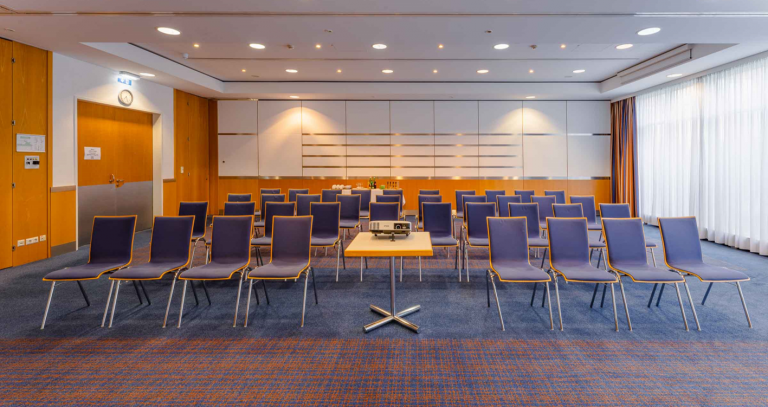
Anyone who has ever had to organise a seminar, conference or company party at short notice knows the problem: at first glance, plenty of venues seem suitable; at second glance, they lack parking, AV equipment, breakout rooms or a realistic quote. This is exactly where it is decided how companies find the right event venue - not through attractive photos, but through clear requirements, genuine comparability and direct communication.
How companies find the right event venue without detours
Getting the order wrong costs the most time in any venue search. Many people start with the city or the style of the venue. It makes more sense to define the occasion properly first. A workshop for 20 people needs something completely different from a kick-off for 150 guests, a Christmas party with an evening programme or a seminar with several working groups.
So at the outset, don't just ask yourself where the event should take place, but what will actually happen there. Do people need to work with focus, network, present or celebrate? Are there fixed programme items that require a change of room? Will external speakers join remotely? The clearer the schedule, the faster the shortlist shrinks to venues that genuinely work.
The next step is about the hard realities of planning: number of participants, budget, date window and accessibility. These four points are not a formality but the basis of every meaningful enquiry. If any one of them remains vague, you will later be comparing quotes that are not really comparable.
The most important selection criteria
The right event venue is never just a matter of taste. Atmosphere plays a part, but it must not overshadow operational suitability. Especially with business events, it quickly becomes clear whether a room merely looks good or whether it can truly carry an event.
Capacity is more than a headcount
Many companies focus on the maximum number of guests. That is not enough. What matters is the setup in which that number works. 80 people in theatre seating is something quite different from 80 people in a U-shape, at workshop islands or at gala tables. If you are not precise here, a room may look suitable on paper and then suddenly feel too cramped or too empty on the day.
Ancillary spaces matter too. Is there a separate reception area, room for catering, quiet zones for speakers or space for group work? For full-day formats in particular, this is exactly what makes the difference between a smooth schedule and improvised rearranging.
Location and accessibility must suit the format
Not every good venue is in the centre, and not every central location is automatically the best choice. For a short meeting, a quick journey is often decisive. For offsites, team-building events or strategy days, a deliberate change of scenery can be more productive than a conference room near the station.
The participants' perspective is what counts. Will they travel by car, by public transport or from several different regions? Is overnight accommodation needed? Is there enough parking? The more mixed the group, the more practical accessibility matters.
Check AV and equipment in concrete terms
Standard specifications such as projector, Wi-Fi or sound system sound good but say little. Ask in more detail. How stable is the Wi-Fi with 100 simultaneous users? Are there wireless microphones, presenters, displays, hybrid technology or a staffed control desk? Which connections are available, and who provides on-site support if something fails?
The same applies to furniture and room layout. Fixed seating can be ideal for conferences but impractical for interactive workshops. Daylight, blackout, acoustics and air conditioning are not side issues. Anyone sitting in a room for eight hours notices every compromise.
Catering, service and timing are part of the overall package
You rarely book an event venue in isolation. Food and drink, service level and on-site processes influence the quality of the entire event. So check whether catering is provided in-house or can be chosen freely. Also clarify when setup can begin, how long you have for breakdown and whether staff are available for reception, AV or evening service.
This is often where it becomes clear whether a quote is genuinely good value or simply incomplete. A low room hire fee can be offset later by extra costs for cleaning, AV, additional hours or furniture.
How to narrow down your options realistically
If you check ten or twenty venues in parallel, you quickly lose track. A shortlist of a few genuinely suitable options is more efficient. You don't need an endless scoring matrix for this, just three clear levels: must-haves, should-haves and nice-to-haves.
Must-haves are non-negotiable, such as capacity, region, budget range, accessibility or available breakout rooms. Should-haves help with prioritisation, for example outdoor space, on-site accommodation or distinctive architecture. Nice-to-haves are everything that enhances the event but does not decide it.
This separation helps you avoid a typical mistake: being dazzled by individual highlights. A roof terrace is attractive, but it is of little help if the venue lacks reliable seminar equipment. Conversely, a less spectacular place can be the better choice if the organisation and flow are right.
Writing enquiries so that quotes become comparable
Many follow-up questions arise not because venue providers communicate unclearly, but because the initial enquiry is too vague. If you only send a date, headcount and a rough idea of the occasion, you will often receive quotes based on assumptions that later have to be corrected.
A short, structured enquiry is better: occasion, date or alternative dates, number of participants, preferred setup, AV requirements, catering wishes and budget range. Stating whether it is a day event, an evening event or a multi-day event also saves time on both sides.
Enquiring directly with the venue has a clear advantage: you clarify details without detours and quickly get a feel for how professionally a venue operates. With business events in particular, response speed is often a good early indicator of the later collaboration. Those who reply promptly and precisely usually deliver reliably too.
Site visits, yes - but at the right time
Not every event venue needs to be visited straight away. A site visit is only worthwhile once availability, budget and basic requirements match. Otherwise, you invest time in venues that would drop out for formal reasons anyway.
During the visit, don't just pay attention to the mood. Look at routes, transitions and operational details. How far is the seminar room from the toilets? Where do queues form? How does the room feel in daylight, and how in the evening? Are there sources of noise that weren't visible in the photos?
If possible, walk through the actual event schedule in your head. Reception, coffee break, session changes, lunch, tech check, evening wind-down. A good venue doesn't just feel good - it reduces organisational friction.
Budget: better honest than optimistic
Budget questions often become concrete too late. Yet a realistic range helps everyone involved. It prevents quotes that miss your needs and creates planning certainty. The key is to look at total costs rather than just room hire.
Depending on the event format, staff costs, AV, catering, accommodation, furniture or cancellation terms can weigh more heavily than the venue hire itself. For larger events in particular, it pays to read a quote line by line. Not to be petty, but to avoid surprises.
A higher price can be justified if it means less external coordination. Conversely, the cheapest solution is not automatically the most economical if you have to organise additional service providers or have too little support on site. It all depends on how much effort can be handled internally.
Why comparability matters so much today
The market is large but not always transparent. Between a hotel, an event space, a seminar centre, a restaurant with a private room and an unusual offsite venue there are worlds of difference - not only in style, but in data quality, availability and scope of service.
That is why structured comparability is becoming ever more important. If you can check capacities, number of rooms, floor space, facilities and price indications at a glance, you make better decisions faster. This is exactly the advantage of digital search and comparison platforms such as JustRoom: you reduce research effort, can filter suitable venues in a targeted way and enquire directly - without commission mark-ups and without unnecessary intermediaries.
This is especially relevant for companies with recurring needs. When several people on a team are involved in the search, you need transparent criteria rather than gut feeling. That makes coordination easier and decisions more robust.
How companies find the right event venue even under time pressure
When the date is close, the temptation grows to book the first available venue. Understandable, but risky. Under time pressure, what counts is not perfection but a clear process. First define your must-haves, then only enquire with suitable options, and decide quickly on the basis of reliable information.
In such cases, direct communication is particularly valuable. Clear quotes, fast replies and transparent terms help more than a large selection without structure. Better three genuinely suitable options than twelve half-suitable ones.
In the end, it's not about finding the most spectacular venue. It's about choosing a place that suits your occasion, your budget and your schedule - and that makes organising easier rather than harder. That is usually the best decision.